
Stop Contracting Agencies From Clipping Your Ticket: How to Manage Tripartite Billing, Purchase Orders, and Retain Control
⚡ Executive Summary & Key Takeaways
- Tripartite Billing Reality: Enterprise consultants deliver value for tier-1 End Clients (e.g. mining or government) but contractually bill via intermediary Billing Entities (recruitment agencies, MSPs) who clip 15–30% margins.
- Data Decoupling is Essential: Generic accounting tools lump all revenue under the agency, corrupting your ATO Personal Services Business (PSB) 80% rule metrics and erasing your direct End Client portfolio history.
- PO Burn Rate Visibility: Real-time consumption tracking of Purchase Order line items (hours, days, fixed milestones) prevents scope creep and payment disputes.
- Wealth Protection: Once paid into your Pty Ltd bank account, profit should be managed via an optimized dividend extraction strategy and protected with a local-first privacy architecture.
In the world of high-end Australian enterprise consulting, your commercial reality rarely fits a simple two-party arrangement. You deliver technical value for an End Client (such as Rio Tinto, Woodside, or a state government utility), but enterprise vendor procurement policies force you to contract through a Billing Entity (a recruitment agency, management consultancy, or MSP) who clips a 15% to 30% margin off your rate.
If you use generic small-business accounting software (FreshBooks, Rounded, QuickBooks), this tripartite structure quickly breaks down.
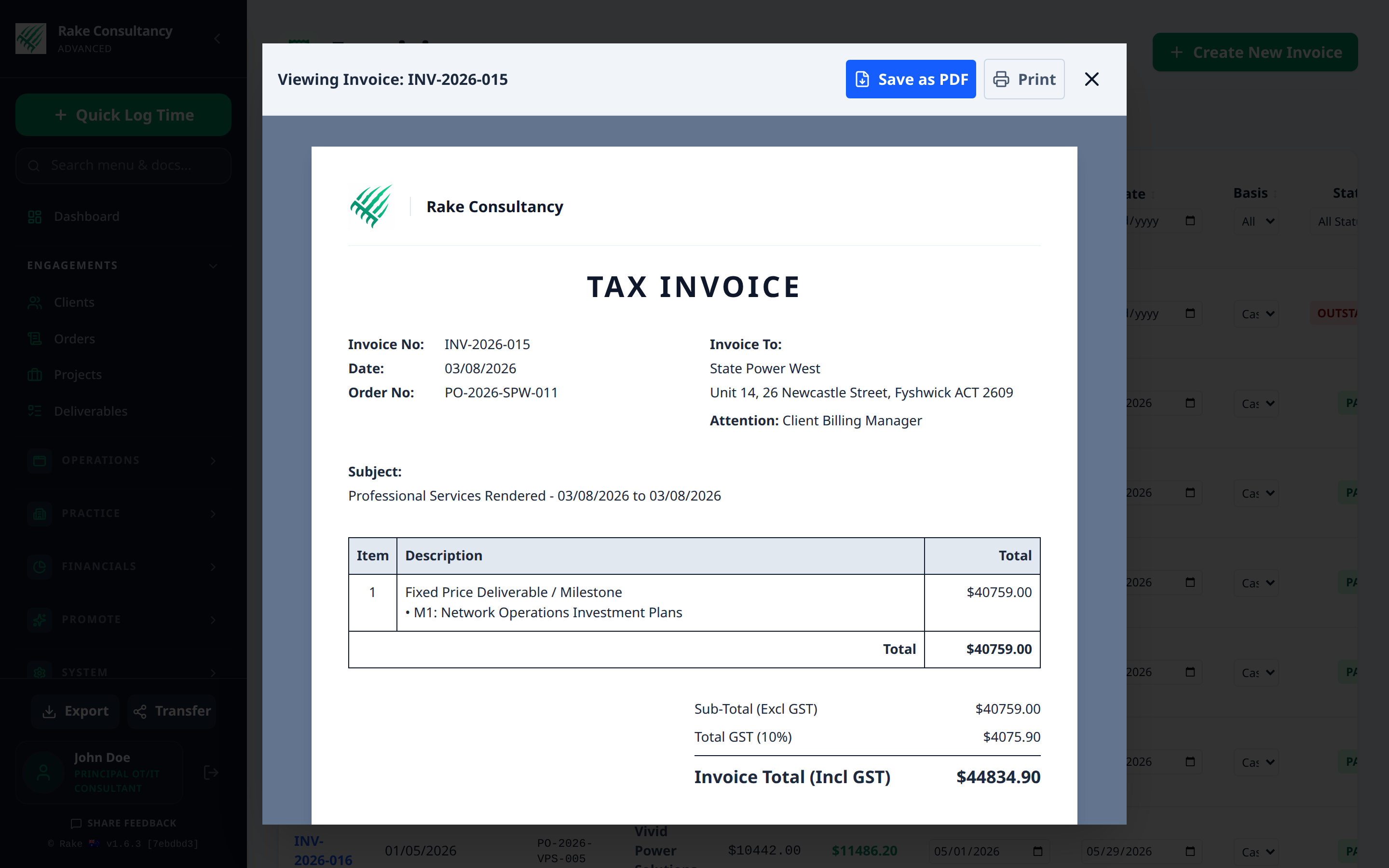
The Architectural Problem: Decoupling Operations from Finances
Traditional accounting systems enforce a rigid 1-to-1 relationship: Client = Invoiced Entity. If you contract through recruitment agencies (e.g. Hays or Paxus), your generic accounting software logs all your revenue under the agency's ABN and bank account details.
📜 The Factual ATO Statutory Evidence
Under Section 80-20 of the Income Tax Assessment Act 1997 (ITAA 1997) and ATO Taxation Ruling TR 2022/3 (Paragraph 48), the ATO explicitly enforces a "look-through" rule:
"If an individual or Personal Services Entity (PSE) provides services to end clients through an intermediary (such as a recruitment agency or labour hire firm), the ultimate end clients are treated as the true sources of the Personal Services Income (PSI)." — ATO TR 2022/3 Paragraph 48
Because traditional software ignores this "look-through" rule, it creates two major legal and commercial traps:
Trap A: The False Failure (3 End-Clients via 1 Recruiter)
If you deliver work for three completely separate mining or energy companies (e.g. BHP, Woodside, Rio Tinto) through a single master-vendor recruitment agency, generic software aggregates 100% of your billings under that recruiter. Your PSI 80% Rule Compliance Tracker will give a false warning that you failed the PSB 80% threshold.
Trap B: The Inverse Trap (1 End-Client via 2 Recruiters / ABNs)
Does the look-through rule work in reverse? YES. Suppose you deliver consulting services for a single end-client (e.g. Rio Tinto) for a full 12 months. Midway through the year, procurement transfers your contract from Agency A (ABN 11 111...) to Agency B (ABN 22 222...), paying you from two different bank accounts and corporate entities.
In standard accounting software, your P&L will show 50% revenue from Agency A and 50% from Agency B—giving you the false impression that no single client accounts for more than 80% of your income. However, under ATO TR 2022/3, the ATO looks through both agencies directly to Rio Tinto. Because 100% of your income originated from Rio Tinto, the ATO treats you as having 100% single-client concentration—causing you to fail the 80% Rule despite billing two separate recruiter ABNs!
🔍 Automated Computer Scanning vs ATO Audit Enforcement
Will initial automated ATO computer systems flag Trap B? On day one, automated Taxable Payments Reporting System (TPAR) data matching scans payment records across different ABNs. Because it sees two separate agency ABNs, it does not trigger an immediate computer-generated alert.
When does the trap spring? During an ATO PSI Compliance Audit or Desk Review. The ATO officer issues a formal information request for your Statements of Work (SOW), timesheets, and project transmittals. The moment the auditor sees both agency contracts were for the exact same End Client site, they apply TR 2022/3 Paragraph 48, collapse both agency payments into 1 single source (100%), cancel your corporate 25% tax rate, reattribute all income to you personally at 47% top marginal rates, and levy back-taxes with GIC interest and penalties (25%–50%).
| System Architecture | Generic Cloud Accounting Tool | Decoupled Contractor Operating System (Rake) |
|---|---|---|
| Data Model | Invoices hardcoded to Single Customer | Organizations decoupled into Billing Entities vs End Clients |
| Purchase Order (PO) Tracking | Basic line items or absent | Multi-unit PO budget tracking (Hours, Days, Milestones) |
| ATO PSI 80% Rule Mapping | Inaccurate (Aggregates agency as 1 client) | Accurate (Calculates income against true End Client per TR 2022/3) |
| White-Label Invoicing | Vendor-branded templates | Pristine, decoupled corporate PDFs with middleman metadata |
Managing Purchase Order (PO) Burn Rates
High-value technical engagements run on formal enterprise Purchase Orders with capped financial limits. Operating without real-time PO consumption visibility leads to unbillable scope creep and delayed payment cycles.
Professional contractors manage engagements using an integrated operational chain:
[Enterprise End Client] ───► [Purchase Order: $120,000 / 100 Days]
                                  │
  ┌───────────────────────────────┴───────────────────────────────┐
  ▼                                                               ▼
[Deliverable A: SCADA Architecture]              [Deliverable B: Commissioning]
Timesheet logged: 20 Days                        Timesheet logged: 15 Days
Remaining PO Budget: 65 Days ($78,000)           Status: Ready to Claim
  │
  ▼
[Auto-Generated Invoicing Engine] ───► Invoices Dispatched to [Billing Middleman]
When hours or days logged on timesheets automatically consume PO line items, milestones transition to "Completed" and trigger invoice generation without duplicate data entry.
Maximizing Your Margin Extraction
Once your invoices are paid by the agency into your Pty Ltd bank account, your focus shifts to structured wealth extraction. Maintaining control over your corporate finances lets you:
- Extract funds up to the $135k Zero Top-Up Tax Sweet Spot.
- Preserve working capital inside your company vault. Read the math in our Sole Trader vs Pty Ltd Comparison ($250k Benchmark).
- Protect sensitive project descriptions, billing rates, and client contracts from third-party data mining by using a Local-First Privacy Architecture.
Frequently Asked Questions
What is tripartite billing in contracting?
Tripartite billing occurs when a consultant delivers services for an End Client (e.g., a tier-1 mining company or government agency), but the commercial contract and invoice payment flow through an intermediary or recruiter (the Billing Entity).
Why do standard invoicing apps break with tripartite agency billing?
Standard accounting software couples the invoicing recipient directly with the project. If you invoice Agency X, the software logs all your project delivery history under Agency X, erasing your true commercial track record with End Clients (e.g. BHP, Rio Tinto) and corrupting your PSI compliance metrics.
How do I prove to the ATO that an agency isn't my sole client?
Keep your underlying Statements of Work (SOW), timesheet transmittal records, and deliverables clearly tagged with the End Client's name and project site. Rake maintains this tripartite audit trail automatically.
If I change recruitment agencies while working for the same End Client, does the ATO count it as 1 client or 2?
The ATO counts it as 1 client. Under ATO TR 2022/3 Paragraph 48, the ATO looks through both agencies to the underlying End Client. Even if you received payments from 2 separate recruiter ABNs and bank accounts, 100% of your PSI originated from the single End Client, meaning you fail the 80% Rule unless you pass the Results Test or another PSB test.
Can I bill on Daily or Milestone units instead of hourly?
Yes. Enterprise contracts often specify daily rates ($1,400/day) or fixed milestone deliverables ($25,000 upon FAT completion). Ensure your system abstracts Units of Measure (UOM) so quantity multiplied by unit rate calculates accurately across timesheets and invoices.
Related Practice & Tax Guides
The $21,000 Pty Ltd Illusion: PSI Rules & Tax Shield
Learn how the ATO's Part 2-42 PSI rules apply to agency contracts and how passing the 80/20 test protects your company tax structure.
Sole Trader vs Pty Ltd at $250k: Corporate Vault Savings
Compare Sole Trader vs Pty Ltd company structures on $250k contractor revenue and calculate how profit retention saves $21,744.
How to Pay $0 Top-Up Tax: The $135k Dividend Sweet Spot
Learn how Australian technical contractors extract franked dividends at a flat 25% corporate tax rate with zero out-of-pocket top-up tax.